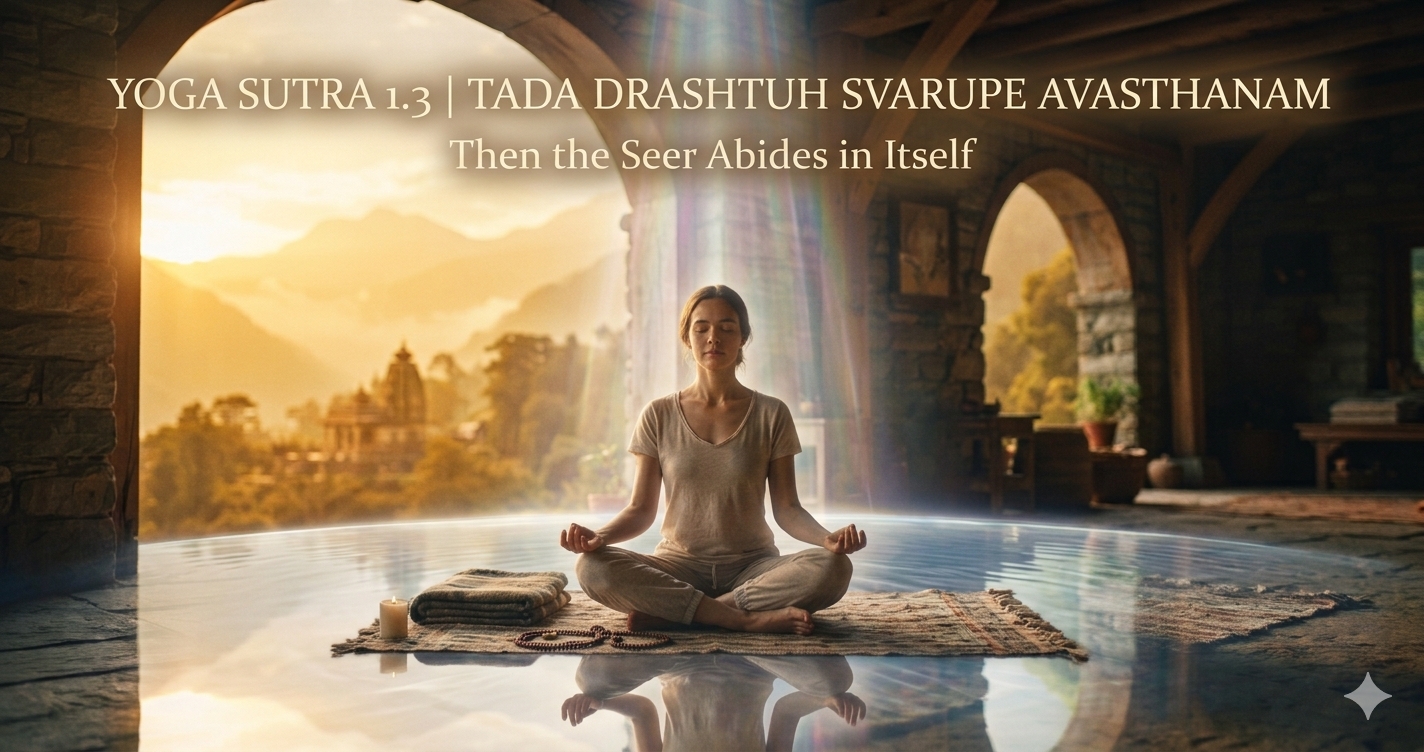
“Tada Drashtuh Svarupe Avasthanam.”
This is one of the most profound statements in Patanjali’s Yoga Sutras.
It follows directly from the previous sutra, “Yogash Chitta Vritti Nirodhah”—Yoga is the stilling of the fluctuations of the mind.
But once the mind becomes still, what happens?
Patanjali gives us the answer in Sutra 1.3:
“Then, the Seer abides in its own true nature.”
Understanding the Words
Each word of this sutra carries a deeper meaning:
Tada — then; at that point, when the fluctuations of the mind have become still.
Drashtuh — the Seer; the one who observes, our deeper Self.
Svarupe — in its own nature; its essential or true nature.
Avasthanam — abiding, remaining, or being established in that state.
So, in a simple sense:
When the mind becomes quiet, the Seer rests in its own true nature.
What Happens When the Mind Becomes Still?
Think about how our mind operates throughout the day.
A thought comes.
Another thought replaces it.
A memory appears.
We react to something someone says.
We worry about tomorrow.
We replay something that happened yesterday.
We imagine what someone might be thinking about us.
This constant movement creates what Patanjali calls vrittis—the fluctuations or modifications of the mind.
And because we are so deeply involved in these fluctuations, we begin to believe that we are them.
If I am angry, I say:
“I am angry.”
If I am anxious:
“I am anxious.”
If I fail:
“I am a failure.”
If I succeed:
“I am successful.”
Our experiences become our identity.
But Patanjali asks us to look a little deeper.
Who Am I Beneath My Personality?
From the time we are born, we gradually collect information about ourselves.
Our parents tell us who we are.
Teachers influence us.
Society gives us expectations.
Our education shapes us.
Our achievements give us a sense of identity.
Our failures leave impressions.
Our relationships, experiences, beliefs and circumstances continue adding layers.
Slowly, we construct a personality and begin to call it “me.”
This personality is real in the sense that it exists and functions in the world.
But is it the entirety of who we are?
Patanjali invites us to look beyond this surface identity.
The Two Identities We Experience
There can be a fascinating inner movement between two ways of experiencing ourselves.
One is the constructed identity—the person shaped by our memories, conditioning, roles, relationships, achievements, failures and experiences.
The other is the Seer—the awareness that can observe all of these.
You can observe your thoughts.
You can observe your emotions.
You can observe your memories.
You can even observe the changing roles you play in life.
So perhaps the question becomes:
If I can observe all these things, am I only these things?
This is where concentration and meditation become important.
As the mind gradually becomes quieter, we begin to create a little distance from the constant chatter.
And in that quietness, we may begin to experience something deeper than our usual personality.
From Identification to Recognition
The purpose of Yoga is not to create another personality or give us a new identity.
It is to help us recognize what is already present beneath the layers of mental activity.
At first, we may experience moments of stillness only briefly.
The mind wanders.
We bring it back.
It wanders again.
We bring it back again.
Gradually, concentration becomes steadier.
The constant noise begins to settle.
And as the noise settles, awareness becomes clearer.
We begin to notice that our thoughts are changing—but the awareness observing them remains.
Our emotions change.
Our circumstances change.
Our roles change.
But the Seer remains the observer of these changes.
This is what Patanjali points towards with Svarupe Avasthanam—abiding in one’s own nature.
The Deeper Question Within Us
Perhaps, somewhere beneath all our achievements and responsibilities, there is a quiet human longing to understand:
“Who am I, really?”
Not my profession.
Not my relationships.
Not my achievements.
Not my failures.
Not even the endless stream of thoughts passing through my mind.
But who am I beneath all of these?
Yoga does not ask us to answer this question intellectually.
It gives us a method of exploring it through practice.
Through concentration.
Through meditation.
Through self-observation.
Through becoming increasingly aware of the movements of the mind.
And gradually, we begin to experience rather than merely think about the distinction between the changing mind and the awareness that observes it.
A Simple Practice
The next time you sit quietly for a few minutes, don’t try to fight your thoughts.
Simply observe.
A thought comes—notice it.
A memory comes—notice it.
An emotion arises—notice it.
Then gently ask yourself:
“Who is noticing all of this?”
Don’t rush to find an intellectual answer.
Simply remain with the awareness of observing.
Even a few moments of this can give us a glimpse into what Patanjali is pointing towards.
When the mind becomes quiet, we begin to see that we are more than the constant movement of the mind.
And in that stillness, the Seer begins to rest in its own true nature.
Tada Drashtuh Svarupe Avasthanam.