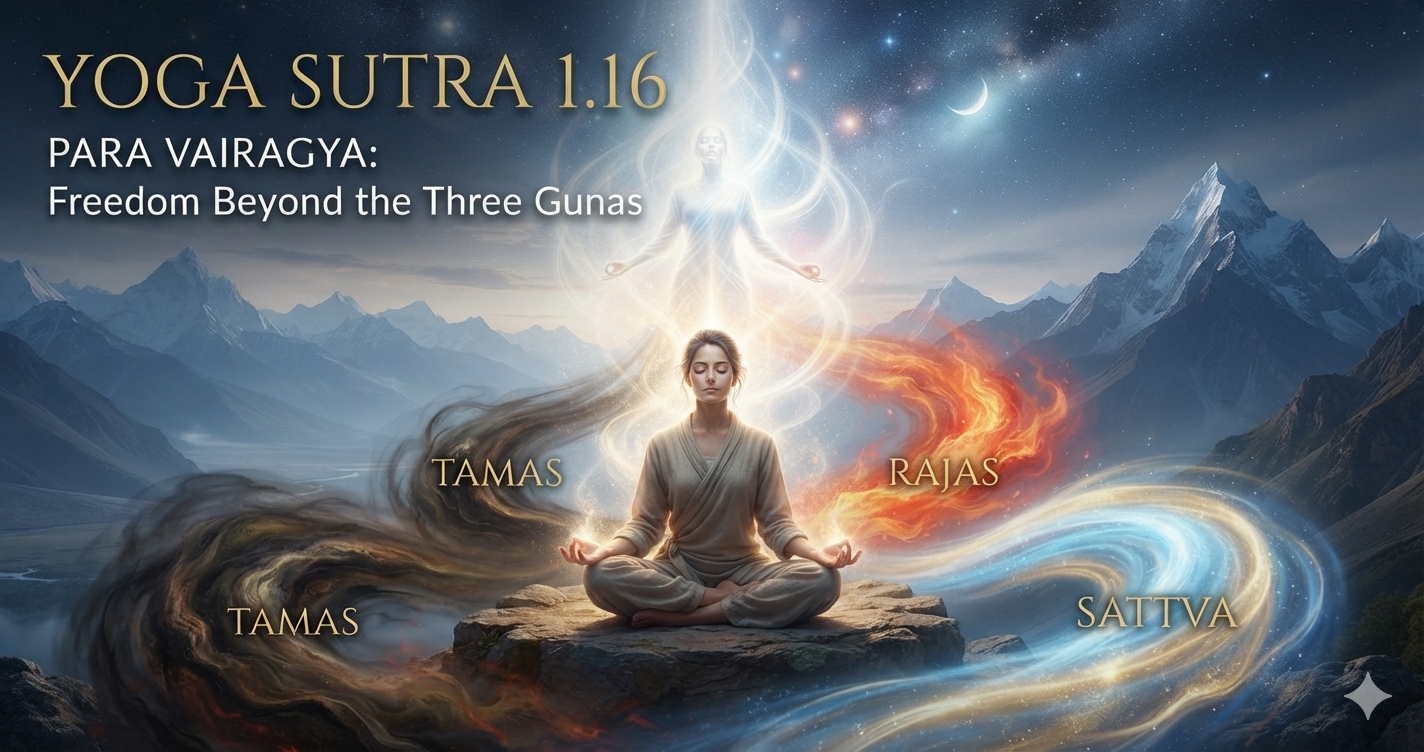
Tat-paraṁ puruṣakhyāter guṇa-vaitṛṣṇyam
Meaning:
The highest form of detachment is freedom from craving even for the three Gunas, arising from clear knowledge of Purusha.
In Sutra 1.15, Patanjali introduced Vairagya — freedom from craving for the objects and experiences of the world.
Now, in Sutra 1.16, he takes Vairagya to its highest level.
This is Para Vairagya — supreme detachment.
The distinction is subtle but important.
From detachment from objects to detachment from Prakriti itself
In ordinary Vairagya, we gradually become less dependent on things outside us.
We may still enjoy wealth, relationships, comfort, success and beautiful experiences, but we are no longer completely dependent upon them for our happiness.
Para Vairagya goes much deeper.
According to the Yoga-Samkhya framework, everything that belongs to the changing field of Prakriti is influenced by the three Gunas:
Sattva — clarity, harmony, lightness and balance.
Rajas — activity, desire, movement and restlessness.
Tamas — heaviness, inertia, dullness and resistance.
Our body, senses, thoughts, emotions, personality and mental states all belong to this changing field.
Even a beautiful state of peace or clarity is still a state that comes and goes.
Para Vairagya means that the seeker is no longer thirsty even for these changing qualities.
Why?
Because through Puruṣakhyāti — clear knowledge of Purusha — one recognises the distinction between:
Prakriti — everything that is experienced and changes
and
Purusha — the conscious Seer who is aware of those changes.
The central shift
This is the heart of Sutra 1.16.
We normally say:
“I am happy.”
“I am angry.”
“I am peaceful.”
“I am restless.”
But with deeper awareness, we begin to see:
Happiness is being experienced.
Anger is being experienced.
Peace is being experienced.
Restlessness is being experienced.
The experiences change.
But there is an awareness of those experiences.
That awareness is what Patanjali points towards as Purusha.
So Para Vairagya is not merely:
“I don’t need this object.”
It is a much deeper recognition:
“Whatever I can experience, observe or possess is changing. Therefore, it cannot be the entirety of who I am.”
Does this mean giving up everything?
No.
This is perhaps the most important practical clarification.
Para Vairagya is not simply physical renunciation.
You do not have to throw away your possessions, leave your family or withdraw from society to begin understanding this teaching.
A person can own very little and still be deeply attached.
Another person can live comfortably, have wealth and possessions, and yet understand that none of these define the Self.
The external lifestyle is not the ultimate measure.
The transformation is within our identification.
An Urban Yogi may have a successful career, a beautiful home and material comforts, yet understand:
“I use these things. I enjoy them. I am grateful for them. But they are not the essence of who I am.”
Even Sattva must eventually be transcended
This is what makes Sutra 1.16 different from Sutra 1.15.
We may think:
“If Rajas and Tamas are disturbing, I should become completely Sattvic.”
Cultivating Sattva is certainly valuable on the yogic path. Clarity, harmony and discrimination create favourable conditions for deeper practice.
But Patanjali goes further.
Even attachment to Sattva must eventually be transcended.
Why?
Because Sattva too belongs to Prakriti.
The ultimate freedom is not:
“I want to remain in a peaceful state forever.”
It is:
“I recognise peace as an experience that arises and passes, and I am not dependent upon any particular mental state to know myself.”
That is the depth of Para Vairagya.
A simple practice for daily life
You don’t have to try to achieve the highest state immediately.
Begin by noticing the distinction between experience and the one experiencing it.
When you feel angry, instead of only saying:
“I am angry,”
pause and notice:
“Anger is present, and I am aware of it.”
When you feel peaceful:
“Peace is present, and I am aware of it.”
When you feel restless:
“Restlessness is present, and I am aware of it.”
You are not denying the experience.
You are simply noticing that the experience is changing, while awareness is capable of observing that change.
Sit quietly for five minutes each day and observe thoughts, emotions, sensations and breath without trying to control them.
Then gently ask:
“What is it that knows all these changing experiences?”
Don’t rush to find an intellectual answer.
The practice is in observing.
The deeper message
Sutra 1.15 teaches us:
“I can live without being controlled by what I desire.”
Sutra 1.16 takes us further:
“I can recognise that even the changing qualities of body and mind are not the ultimate Self.”
That is the movement from Vairagya to Para Vairagya.
From letting go of craving for objects,
to letting go of identification with Prakriti,
to recognising Purusha — the Seer.
This is why Sutra 1.16 is not simply a teaching about giving things up.
It is ultimately a teaching about knowing what you are — and what you are not.
Things change.
The body changes.
The mind changes.
Emotions change.
States of consciousness change.
Yoga asks us to discover that which is aware of all these changes.
That recognition is the deeper foundation of freedom.