“Pramana Viparyaya Vikalpa Nidra Smritayah.”
In Sutra 1.5, Maharshi Patanjali tells us that the movements of the mind, or vrittis, are of five kinds.
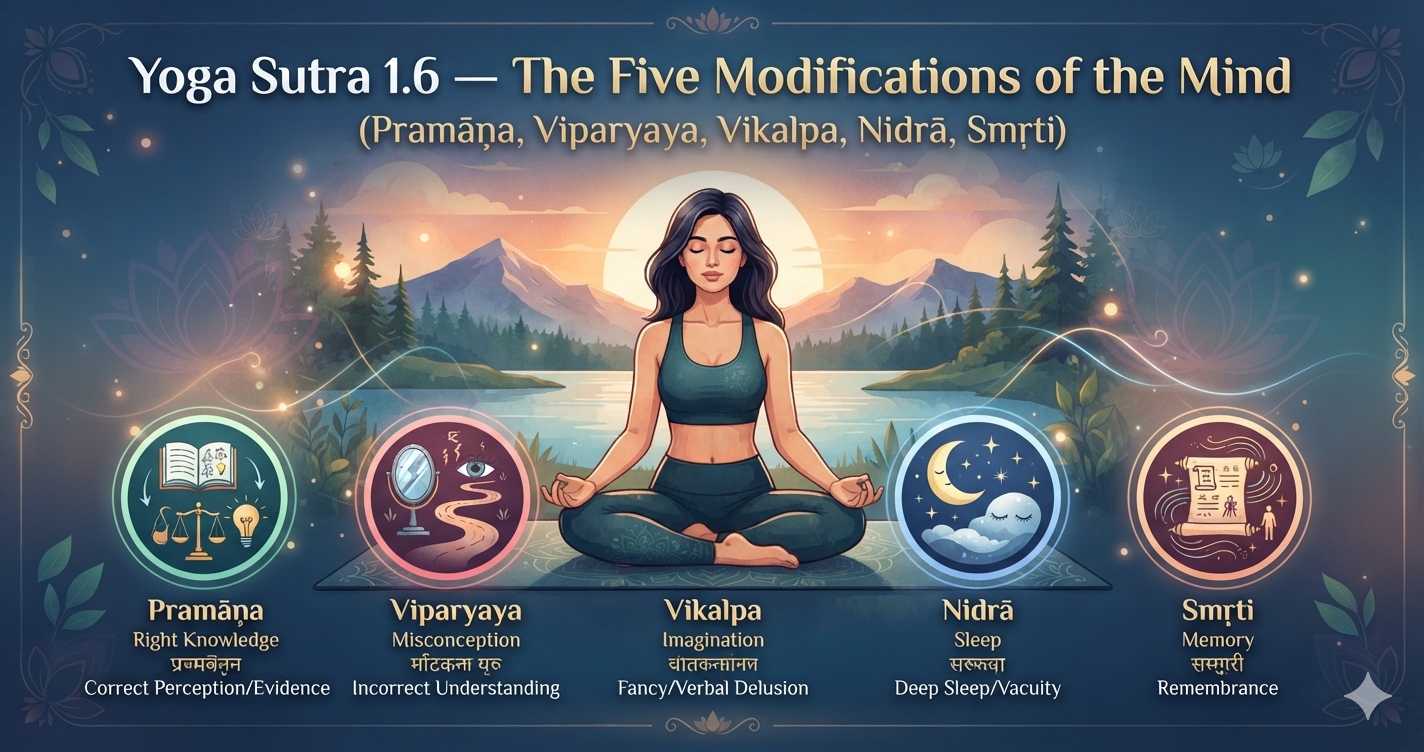
In Sutra 1.6, he identifies them:
- Pramana — right or valid knowledge
- Viparyaya — wrong or mistaken knowledge
- Vikalpa — imagination or conceptualisation
- Nidra — sleep
- Smriti — memory
These five describe some of the fundamental ways in which the mind operates.
The Mind Is Constantly Moving
Have you ever noticed that even when the body is sitting still, the mind rarely is?
One moment we are thinking about something that happened yesterday. The next, we are planning tomorrow. We remember an old conversation, imagine a future possibility, interpret someone’s words or create an entire story around something that has just happened.
This constant movement is the nature of the mind.
Patanjali helps us understand that much of our inner experience is shaped through these five forms of mental modification.
The mind perceives and knows, misunderstands, imagines, sleeps and remembers.
And when we become completely identified with these movements, they begin to influence the way we experience ourselves and the world around us.
How the Gunas Influence the Mind
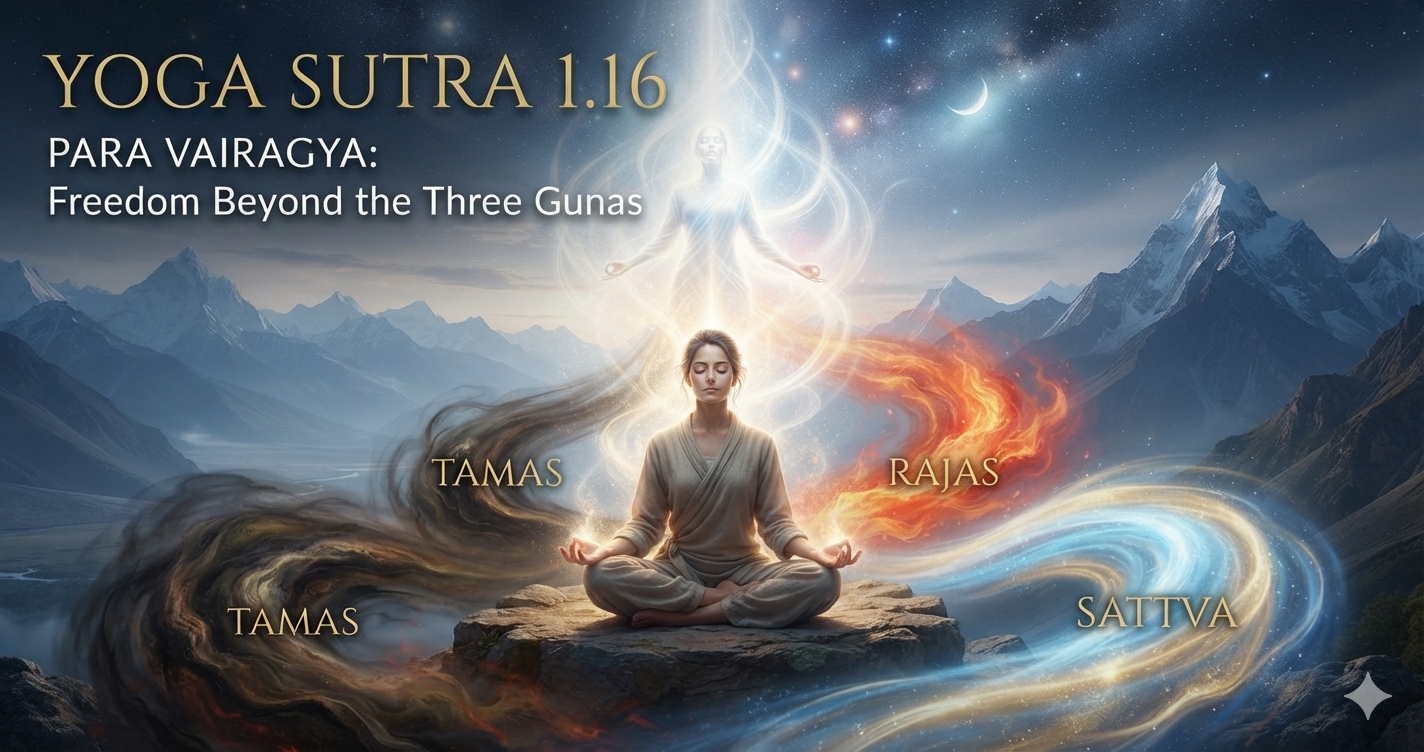
The functioning of the mind can also be understood through the three gunas—Sattva, Rajas and Tamas.
When Sattva is predominant, the mind tends towards clarity, balance, discrimination and greater access to intelligence and understanding.
When Rajas is predominant, the mind becomes more active, restless and driven towards action, desire and constant engagement.
When Tamas is predominant, there may be greater heaviness, dullness, inertia and a tendency towards unconscious or habitual functioning.
These are not fixed personality types. The balance of the gunas can change according to our thoughts, lifestyle, environment, food, sleep, habits and state of awareness.
This is why the yogic approach is not simply to control the mind, but to gradually cultivate the conditions for a clearer, steadier and more balanced mind.
The Roaming Mind and the Images It Creates
The mind has a natural tendency to move.
Give it a few moments of silence and it may immediately produce a thought, memory, image or possibility.
Sometimes these mental images are useful.
But sometimes the mind creates an experience that has little connection with what is actually happening in the present.
We imagine what someone might say.
We replay what someone did.
We worry about what could happen.
We create stories about ourselves and others.
Over time, these repeated thoughts and emotional reactions can become deeply established patterns.
We may then begin to live according to the images created by the mind rather than responding to reality as it is.
This is one reason Patanjali places such importance on understanding the vrittis.
Are All Vrittis Painful?
Not necessarily.
Some mental modifications may contribute to clarity, learning and constructive action, while others may create confusion, attachment, fear or suffering.
What becomes important is our relationship with the vritti.
A thought may arise, but do we have to believe it?
An emotion may arise, but do we have to act from it?
A memory may appear, but do we have to allow it to define the present?
The yogic practice is to gradually develop the ability to observe the movement without immediately becoming identified with it.
From Mental Modification to Pure Awareness
When the mind is constantly moving, our attention is continually pulled outward and into different mental experiences.
But as concentration develops, we begin to gather this scattered attention.
Through practices such as Dharana, meditation, pranayama and self-observation, the mind can gradually become steadier.
The purpose is not to destroy the mind.
The purpose is to develop a relationship with the mind in which we are able to observe its movements without being completely controlled by them.
As identification with the vrittis becomes weaker, awareness becomes clearer.
This takes us back to what Patanjali described in Sutra 1.3:
“Tada Drashtuh Svarupe Avasthanam” — Then the Seer abides in its own true nature.
What Comes Next?
From Sutra 1.4 to Sutra 1.11, Patanjali takes us deeper into the nature of these mental modifications.
He begins to explain how knowledge, mistaken perception, imagination, sleep and memory function as vrittis, and how these movements can influence our experience of life.
This is particularly relevant to our everyday lives because we may not always be able to control the situations we encounter.
But we can gradually become aware of how our mind interprets and responds to them.
The same situation can create very different experiences depending on the thoughts, memories, perceptions and reactions we attach to it.
And this is where Yoga becomes a practical path.
We may not be able to stop every thought from arising, but we can learn to observe the mind before allowing every thought to become our reality.
As awareness deepens, the mind becomes less scattered, our responses become more conscious, and we gradually move from mental modification towards inner stillness and clarity.