
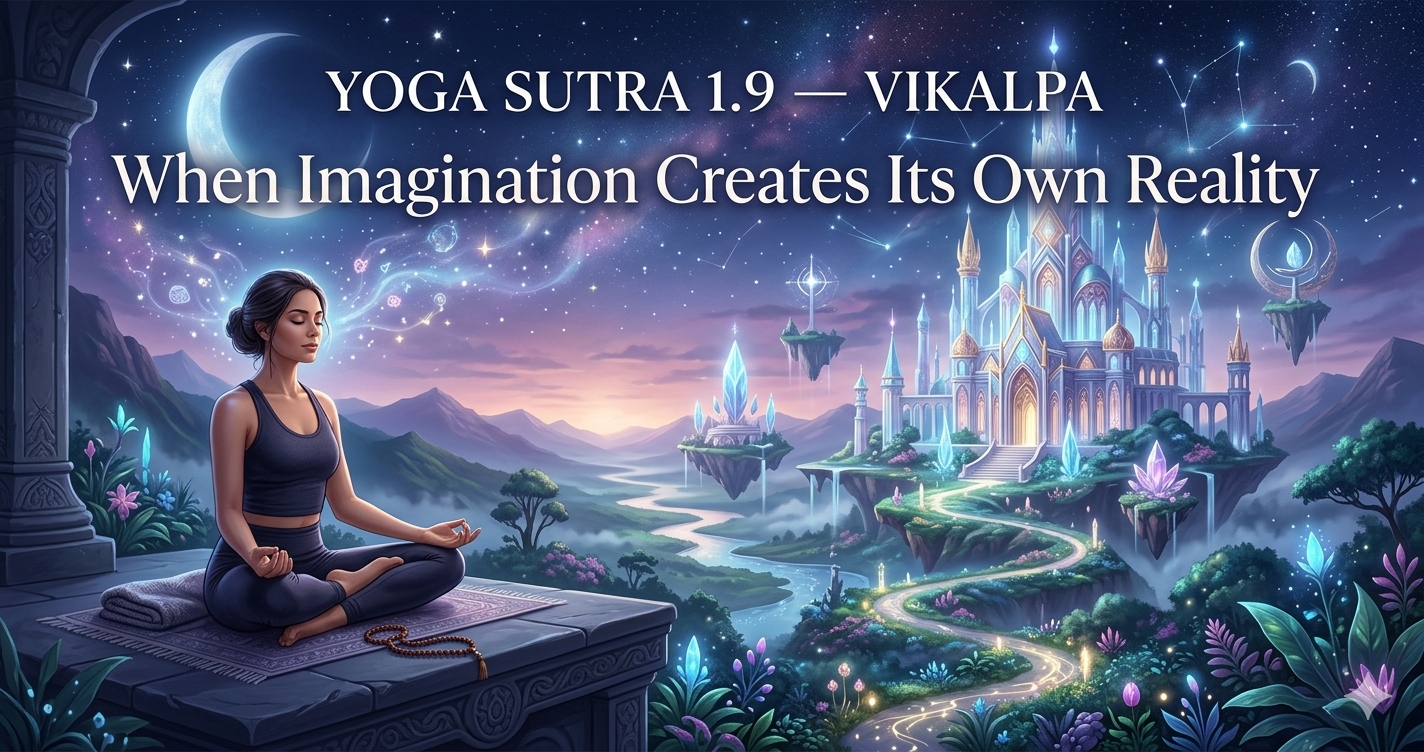
“Shabda Jnana Anupati Vastu Shunyo Vikalpah.”
Patanjali defines Vikalpa as a mental modification that arises from words, concepts or ideas without a corresponding reality behind them.
In simple terms:
The mind creates an idea, gives it meaning, and begins to experience it—even though there may be no actual reality corresponding to that idea.
This is the power of imagination.
And imagination, by itself, is neither good nor bad.
It can inspire us, help us create, dream and explore possibilities.
But when imagination is mistaken for reality, it can also become a source of unnecessary fear, anxiety and suffering.
When the Mind Creates a Story
The mind has an extraordinary ability to fill in gaps.
We don’t always know what is happening, so the mind creates an explanation.
Someone doesn’t call us back.
We start wondering why.
Someone looks serious while speaking to us.
We assume they are upset.
We see something that is incomplete or ambiguous, and the mind quickly creates a story to make sense of it.
The problem begins when we stop recognizing the story as a possibility and start treating it as a fact.
Imagination Can Be Positive Too
Imagine a child seeing lightning during a storm.
Instead of being frightened, she imagines that God is taking her photograph with a camera in the sky.
There is no actual evidence that this is happening.
It is an imaginative interpretation—but for the child, the thought may create wonder rather than fear.
This shows us something important:
Imagination itself is not the problem.
The experience created by imagination can be pleasant or unpleasant depending on the meaning we give it.
When Imagination Creates Suffering
Now consider another situation.
You see your spouse talking and laughing with someone of the opposite sex.
You do not know what they are discussing.
You have no evidence that anything inappropriate is happening.
But the mind begins:
“Why are they laughing like that?”
“Maybe there is something between them.”
“What if they are hiding something from me?”
One thought creates another.
Soon, an entire story has been constructed.
You may feel jealousy, insecurity, anger or hurt—even though you do not actually know what happened.
The situation was real:
Two people were talking.
But everything that followed may have been created by the mind.
And if we repeatedly think about that imagined story, it can become a strong emotional impression.
We may remember the imagined event as though it were something that actually happened.
This is how imagination can move from a simple thought into emotional suffering.
The Difference Between Possibility and Reality
Vikalpa teaches us to recognize an important distinction:
“It is possible” does not mean “it is true.”
This distinction can change the way we respond to everyday situations.
For example:
“Maybe they are upset with me.”
is very different from:
“They are definitely upset with me.”
The first leaves room for reality.
The second turns imagination into certainty.
A mindful person learns to notice this difference.
Ask: What Do I Actually Know?
Whenever you notice yourself becoming emotionally disturbed by a thought, pause and ask:
What do I actually know?
Then separate the experience into three parts:
FACT: What actually happened?
STORY: What am I imagining or assuming about it?
FEELING: What emotion is this story creating within me?
For example:
Fact: My spouse was talking and laughing with someone.
Story: They may be attracted to this person.
Feeling: I feel jealous and insecure.
This simple separation can create space between reality and imagination.
A Small Practice to Master Vikalpa
The next time you notice yourself worrying about something that has not actually happened, try this 3-step Vikalpa Check:
1. Pause
Take three slow, conscious breaths before reacting.
2. Name it
Say to yourself:
“This is a thought, not necessarily a fact.”
3. Verify
Ask:
“What evidence do I actually have?”
If you have no evidence, allow the possibility that your mind may simply be creating a story.
You don’t have to force the thought away.
Simply observe it without immediately believing it.
With practice, you begin to create a healthy distance between what the mind imagines and what reality actually presents.
From Imagination to Awareness
Patanjali is not asking us to stop imagining.
Imagination is an important human capacity. It allows us to create, plan, dream and envision possibilities.
The practice of Yoga is to become aware of when imagination is useful and when it is creating unnecessary mental disturbance.
When we can recognize:
“This is something I am imagining.”
rather than:
“This is definitely true,”
we create space for clarity.
And sometimes, that small space is enough to prevent an imagined situation from becoming real suffering.
The mind can create a story in seconds.
Yoga teaches us to pause before we make that story our reality.
This also gives you a strong transition into Sutra 1.10 — Nidra, because after exploring how the mind can create an imagined reality, Patanjali next examines another subtle state of mind: sleep and the mental modification associated with it.