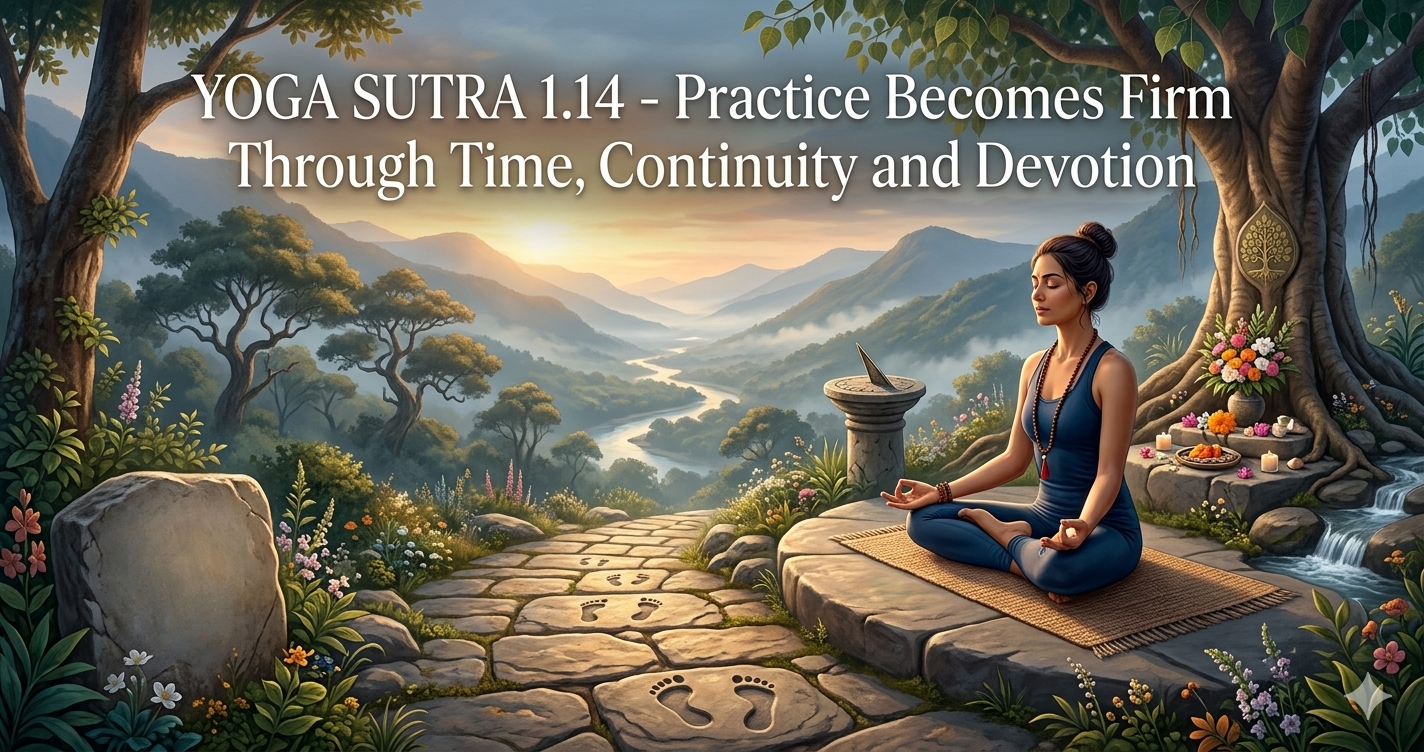
Sa tu dīrgha-kāla-nairantarya-satkārāsevito dṛḍha-bhūmiḥ
Meaning:
That practice becomes firmly established when it is cultivated for a long time, without interruption, and with sincere dedication and reverence.
In the previous Sutra, Patanjali explained Abhyasa — the effort to remain steady.
But an important question naturally follows:
How does practice become truly established within us?
Patanjali answers:
Through time, continuity and sincere commitment.
A practice that we do occasionally may give us an experience.
A practice that we continue consistently can eventually become part of who we are.
Three qualities that make practice firm
Patanjali gives us three important dimensions of practice:
Dīrgha-kāla — for a long time
Some changes require patience. We cannot expect a deeply rooted pattern to disappear after a few days of practice.
Nairantarya — without interruption
Consistency matters. We keep returning to the practice rather than repeatedly starting and stopping.
Satkāra-āsevita — with respect, sincerity and wholeheartedness
We don’t practise mechanically or merely because someone has told us to. We develop a genuine understanding of why the practice matters and approach it with care and dedication.
Together, these make the practice dṛḍha-bhūmi — firmly grounded.
Why do we give up practices that are good for us?
We have all experienced this.
Someone we respect tells us:
“You should meditate every day.”
Or:
“Start exercising.”
“Practise pranayama.”
“Wake up early.”
“Change your eating habits.”
We understand the benefits.
We may even begin enthusiastically.
But if we are doing it only because someone influential told us to, without understanding how it connects to our own life and well-being, the practice can quickly become a burden.
One day we are tired.
The next day we are busy.
Then the mind starts offering reasons:
“I’ll do it tomorrow.”
“I don’t have enough time.”
“It isn’t making much difference.”
“I’ll start properly next Monday.”
Before we know it, the practice has disappeared.
The problem may not be the practice itself.
Sometimes, our relationship with the practice has not yet become strong enough.
Understanding creates commitment
When we understand why we are doing something, practice begins to feel different.
Suppose you practise pranayama simply because someone told you to.
It may feel like another item on your to-do list.
But when you begin to understand your own breath, notice how it changes with stress, and experience how conscious breathing helps you settle, the practice becomes personal.
You are no longer doing it merely because someone asked you to.
You have experienced its value.
That understanding creates a deeper commitment.
Bring love into the practice
There is another beautiful dimension to this Sutra.
A practice becomes easier to sustain when it is not performed with constant resistance.
Whether it is yoga, meditation, exercise, healthy eating, prayer, studying or developing a new habit, ask yourself:
“Can I learn to enjoy this process?”
Instead of thinking:
“I have to do this.”
can we gradually move towards:
“I choose to do this because I know what it gives me.”
That shift can completely change our experience.
Even a challenging practice can become meaningful when it is approached with love, reverence and understanding.
Don’t measure every practice by immediate results
We often abandon something because we don’t see quick results.
But many of the most important changes in life are happening quietly.
A single meditation may not transform your mind.
One healthy meal may not transform your body.
One day of exercise may not make you fit.
One calm response may not change your personality.
But repeated choices gradually create new patterns.
What is repeated becomes familiar.
What becomes familiar becomes easier.
What becomes easier can become natural.
This is how practice becomes firmly rooted.
A simple reflection
Think of one practice you genuinely want to establish in your life.
Now ask yourself:
1. Why am I doing this?
Do I truly understand its value?
2. Can I make it consistent rather than perfect?
What is the smallest version I can sustain?
3. Can I approach it with enjoyment rather than punishment?
How can I make the practice meaningful to me?
For example, instead of deciding:
“I will meditate for 30 minutes every day.”
and abandoning it after four days, you might begin with:
“I will sit quietly for five minutes every morning, and I will do it consistently.”
The goal is not to impress yourself with intensity.
The goal is to build something that stays.
The deeper message of Sutra 1.14
Patanjali is reminding us that transformation is not created by occasional bursts of enthusiasm.
It is created through steady repetition over time.
Practice needs patience.
It needs continuity.
And it needs a relationship of respect and sincerity.
When we understand why we are practising, when we choose to continue even when the initial excitement fades, and when we bring love and devotion into the process, the practice gradually moves from something we do to something we embody.
Eventually, we don’t have to constantly convince ourselves to practise.
The practice becomes part of us.
That is dṛḍha-bhūmi — a firm foundation.
And perhaps the simplest takeaway from Sutra 1.14 is:
Don’t chase intensity.
Build continuity.
Do it for long enough, consistently enough, and sincerely enough — and what once required effort can eventually become natural.