

Dṛṣṭānuśravika-viṣaya-vitr̥ṣṇasya vaśīkāra-saṁjñā vairāgyam Meaning: Vairagya is the state of mastery in one who is free from craving for objects and experiences that have been seen…
Continue Reading....Day: October 6, 2026
Yoga Sutra 1.14 — Practice Becomes Firm Through Time, Continuity and Devotion
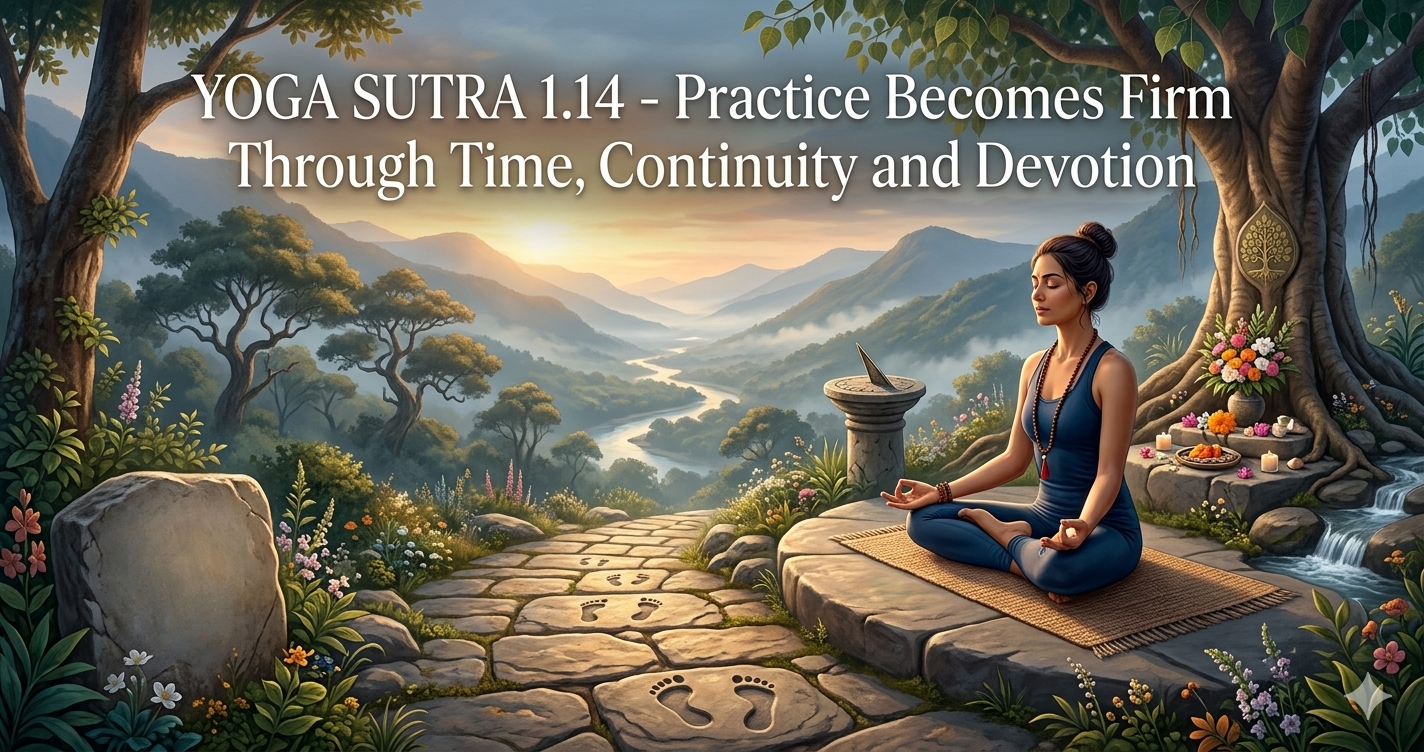
Sa tu dīrgha-kāla-nairantarya-satkārāsevito dṛḍha-bhūmiḥ Meaning: That practice becomes firmly established when it is cultivated for a long time, without interruption, and with sincere dedication and…
Continue Reading....Yoga Sutra 1.13 — Abhyasa: The Practice of Remaining Steady

Tatra sthitau yatno ‘bhyāsaḥ Meaning: Abhyasa is the effort to remain established in that state of steadiness. In the previous Sutra, Patanjali introduced two essential…
Continue Reading....Yoga Sutra 1.12 — Abhyasa and Vairagya: The Two Foundations of a Steady Mind

Abhyāsa-vairāgyābhyāṁ tan-nirodhaḥ Meaning: The modifications of the mind are restrained through Abhyasa — consistent practice — and Vairagya — non-attachment. Until now, Patanjali has been…
Continue Reading....Yoga Sutra 1.11 — Smriti: When the Past Shapes the Present

Anubhūta-viṣayāsampramoṣaḥ smṛtiḥ Meaning: Smriti, or memory, is the retention of an experienced object or experience, allowing it to be recalled. With this Sutra, Patanjali introduces…
Continue Reading....Yoga Sutra 1.10 — Nidra: Understanding the Mind in Sleep

Abhāva-pratyayālambanā vṛttir nidrā Meaning: Nidra, or sleep, is a mental modification in which the mind takes the cognition of absence as its object. After explaining…
Continue Reading....Yoga Sutra 1.9 — Vikalpa: When Imagination Creates Its Own Reality

“Shabda Jnana Anupati Vastu Shunyo Vikalpah.” Patanjali defines Vikalpa as a mental modification that arises from words, concepts or ideas without a corresponding reality behind…
Continue Reading....Yoga Sutra 1.8 — Viparyaya: When We Mistake What Is Not True

Viparyayo Mithyajnanam Atadroopa Pratishtham Meaning: Viparyaya is mistaken knowledge—an understanding that does not correspond to the true nature of the object. Patanjali now introduces…
Continue Reading....