A Practical Daily Yoga Takeaway
The teachings of Patanjali need not remain limited to philosophy or a yoga mat. We can bring them into our everyday lives through small, consistent practices.
Try this simple 10-minute daily Sadhana:
- One minute – Pause
Before beginning your day, sit quietly and observe your present state of mind. Are you restless, tired, distracted, peaceful or energized? Simply notice without judging yourself. - Three minutes – Move
Practice a few simple Yoga postures with awareness. Focus less on how the posture looks and more on how your body feels. - Two minutes – Breathe
Bring your attention to your breath. Allow it to become slow, steady and comfortable. Let the breath become an anchor for your attention. - Two minutes – Observe
Sit quietly and watch your thoughts without immediately reacting to them. You don’t have to stop the thoughts; simply observe them. - Two minutes – Reflect
Ask yourself:
What quality do I want to cultivate today?
More discipline? Patience? Clarity? Compassion? Courage? Balance?
Carry that intention with you into your day.
This simple practice brings the essence of the four Padas into daily life:
Samadhi Pada — Become aware of the mind.
Sadhana Pada — Practice consistently.
Vibhuti Pada — Develop deeper concentration.
Kaivalya Pada — Move towards greater inner freedom.
You don’t need to change your entire life overnight.
Start with awareness. Add discipline. Practice consistently. Let transformation happen gradually.
Your Yoga begins with the next conscious breath.
Some important quotes from Samkhya Yoga sutra from Maharshi Patanjali
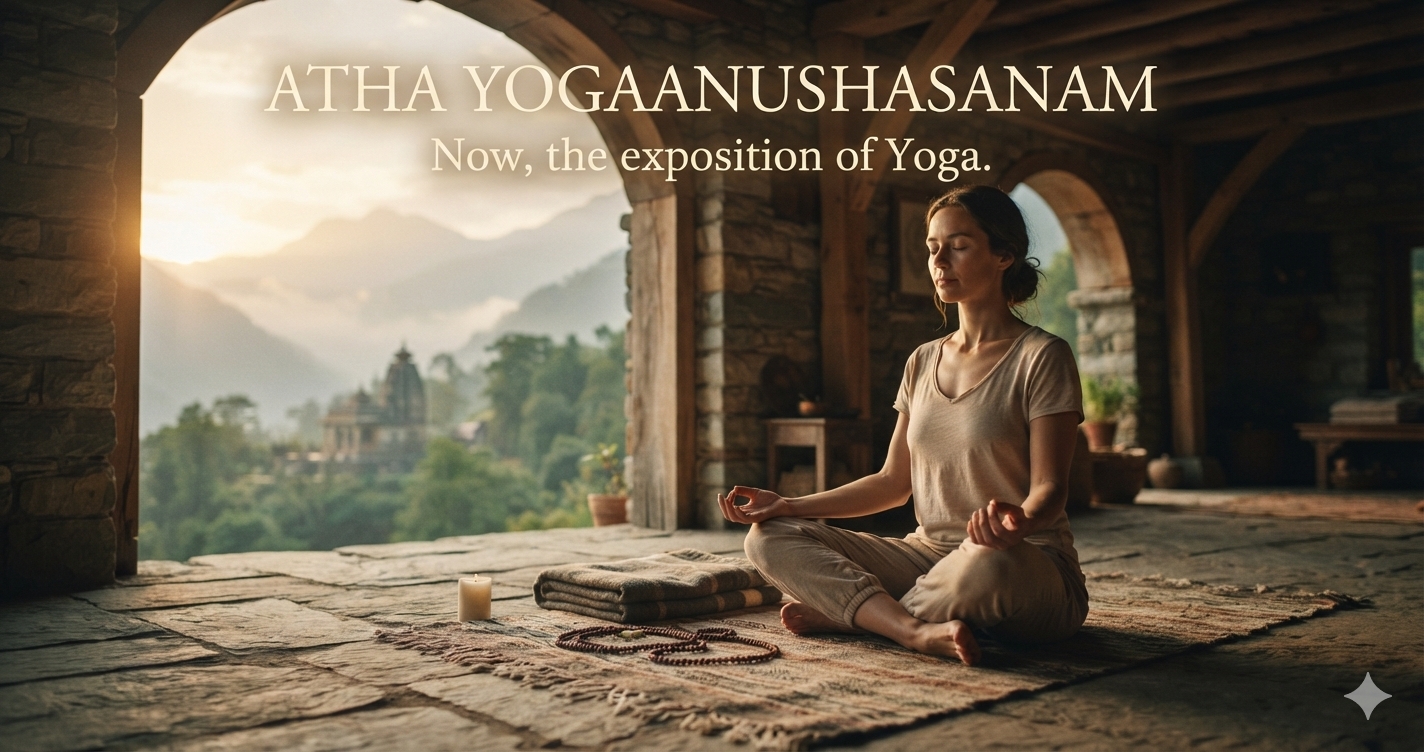
1.1 Atha Yoganushasanam
The very first aphorism reminds us of something fundamental: when you commit yourself to fitness, personal growth, or any goal in life, the first step is discipline—starting NOW.
Yog means union. In the Sankhya-Yoga perspective, it can be understood as the journey towards the union of the Atman with the Paramatman. But yoga can also be understood more practically—as a journey of the self towards becoming more balanced, aware, and aligned with our personal and professional goals.
To undertake this journey, we can take the support of Ashtanga Yoga—the eight limbs of yoga.
These eight limbs help us discipline and gradually rearrange different dimensions of our life—our actions, body, breath, senses, mind, thoughts, emotions, and ultimately our awareness.
Yoga, therefore, is not simply about flexibility or physical postures. It is a process of bringing ourselves into alignment—inside and out.
And that alignment begins with one simple decision:
“I commit to myself. I begin NOW.”