Abhyāsa-vairāgyābhyāṁ tan-nirodhaḥ
Meaning:
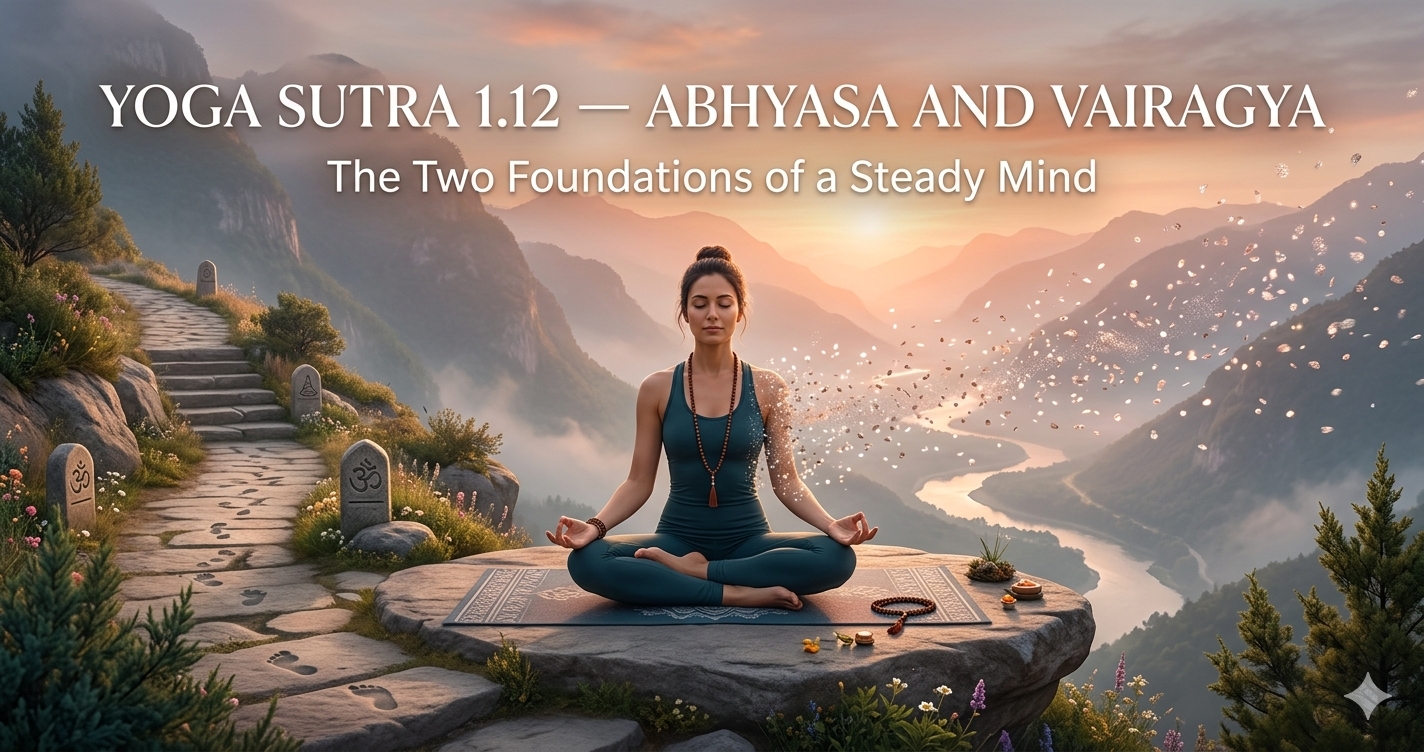
The modifications of the mind are restrained through Abhyasa — consistent practice — and Vairagya — non-attachment.
Until now, Patanjali has been helping us understand how the mind moves.
In Sutra 1.6, he introduced the five Vrittis — Pramana, Viparyaya, Vikalpa, Nidra and Smriti.
We saw how the mind can perceive, misunderstand, imagine, sleep, remember and create interpretations.
Now comes a very important question:
If the mind is constantly moving, how can we become steadier?
Patanjali gives us a remarkably simple answer:
Abhyasa and Vairagya.
Two complementary qualities:
Practice + Non-attachment.
What is Abhyasa?
Abhyasa means consistent, repeated practice.
It is not about doing something perfectly once.
It is about returning to it again and again.
If you want a calm mind, you practise calming the mind.
If you want greater awareness, you practise observing yourself.
If you want healthier habits, you repeatedly choose healthier actions.
Over time, repetition creates familiarity, and familiarity can become a tendency.
This is where the commentary of Swami Vivekananda becomes particularly interesting.
Our habits shape our character
Swami Vivekananda places great emphasis on the power of habit.
Much of what we call our personality or character is built through repeated thoughts, actions and responses.
If we repeatedly practise kindness, kindness becomes easier.
If we repeatedly practise patience, patience becomes stronger.
If we repeatedly react with anger, anger can become our habitual response.
If we repeatedly give in to fear, fear can begin to influence how we approach life.
In simple words:
What we repeatedly practise, we strengthen.
This also means that we should be careful about labelling ourselves — or others.
We may say:
“He is stupid.”
“She is an angry person.”
“He is a difficult person.”
“She will never change.”
But Yoga gives us another perspective.
Perhaps what we are seeing is not someone’s permanent nature, but a pattern that has been repeatedly practised and strengthened.
A person may have developed a habit of anger without being anger.
Someone may have developed a habit of fear without being fearful.
Someone may have developed unhealthy reactions without being a permanently “bad” person.
And if habits can be strengthened through repetition, they can also be changed through repetition.
The way out of an old habit is to cultivate a new one
We cannot always remove a negative pattern simply by fighting it.
If you keep telling yourself:
“Don’t get angry. Don’t get angry. Don’t get angry.”
your attention is still revolving around anger.
Instead, consciously practise the quality you want to develop.
Instead of repeatedly feeding irritation, practise pausing.
Instead of reacting immediately, practise taking one breath.
Instead of constantly criticising yourself, practise observing yourself with compassion.
Instead of feeding fear, practise taking one small courageous action.
A new pattern becomes stronger when it is repeatedly practised.
This is the practical power of Abhyasa.
What is Vairagya?
The second principle is Vairagya.
It is often translated as detachment or dispassion, but it does not mean becoming emotionless, giving up enjoyment or abandoning your goals.
It means learning to participate fully in life without becoming psychologically dependent on the outcome.
You can have preferences.
You can have ambitions.
You can work hard.
You can enjoy beautiful experiences.
You can love people deeply.
But there is a difference between:
“I would like this.”
and
“I must have this, otherwise I cannot be happy.”
That second position creates attachment.
Preference versus attachment
Imagine you love a particular restaurant.
You go there, enjoy the food and have a wonderful evening.
That is enjoyment.
But if the restaurant is closed the next day and you become disproportionately angry, frustrated or miserable because “I need it to be available,” something has changed.
The problem is no longer the restaurant.
It is our attachment to getting what we want.
Vairagya teaches us:
Enjoy what is available without demanding that it must always be available.
You can appreciate something today while accepting that tomorrow may be different.
You can work towards a goal while accepting that the final outcome is not completely within your control.
You can love someone deeply without trying to possess or control them.
This is not indifference.
It is freedom within involvement.
Osho’s perspective: Drop the attachment, not the joy
Osho’s interpretation of Vairagya beautifully brings out this distinction.
Non-attachment does not mean:
“I don’t want anything.”
It means:
“I can want something without becoming obsessed with having it.”
There is nothing wrong with desire itself.
The difficulty begins when desire becomes attachment, obsession and dependence.
You may say:
“I would love to have this.”
And then work sincerely towards it.
But if it doesn’t happen, can you still remain inwardly balanced?
That is where Vairagya begins.
You enjoy what life gives you.
You work for what you want.
You appreciate what is present.
And yet, you remain open to the possibility that things may change.
Take it. Enjoy it. Appreciate it.
And when it is time to let it go, let it go.
Abhyasa without Vairagya — and Vairagya without Abhyasa
Patanjali places these two together for a reason.
Practice without non-attachment can become rigid.
You may become obsessed with being perfect, achieving results or controlling your progress.
And non-attachment without practice can become an excuse for passivity:
“Whatever happens, happens.”
Yoga asks for something more balanced.
Practise sincerely.
Participate fully.
But don’t become imprisoned by the result.
This is the beautiful balance of Abhyasa and Vairagya.
A small daily practice
Choose one mental or behavioural pattern you would like to change.
For example:
- reacting immediately when irritated
- overthinking before making decisions
- reaching for your phone whenever you feel uncomfortable
- worrying excessively about an outcome
- seeking constant approval from others
For the next seven days:
ABHYASA: Practise one new response every day.
For example, when irritated, take three breaths before responding.
VAIRAGYA: Don’t demand perfection from yourself.
If you react badly one day, don’t say:
“I will never change.”
Simply observe:
“This is an old pattern. Tomorrow I practise again.”
That is Abhyasa.
And when the result doesn’t come exactly as you expected, remind yourself:
“I am responsible for my practice. I cannot control every outcome.”
That is Vairagya.
The deeper message of Sutra 1.12
Patanjali does not tell us to fight the mind.
He shows us how to train it and gradually become less controlled by it.
Our past patterns may influence us, but they do not have to determine our future.
Every time we consciously choose a new response, we are creating a new possibility.
Every time we practise without becoming obsessed with the result, we cultivate inner freedom.
So perhaps one of the most empowering messages of this Sutra is:
You are not permanently defined by your old habits.
Habits can change.
Patterns can change.
Responses can change.
And through Abhyasa and Vairagya, the mind can gradually become steadier.
Practice what you want to become.
Release your attachment to how quickly it happens.
That is the beginning of mastering the mind — not by force, but through consistent practice and inner freedom.