Vitarka-vicārānandāsmitārūpānugamāt samprajñātaḥ
Patanjali now takes us deeper into the meaning of Samadhi. After explaining Abhyasa and Vairagya, he begins to describe what happens when the mind becomes deeply steady and absorbed in meditation.
Samprajñāta Samadhi can be understood as Samadhi with conscious awareness or knowledge. In this state, the mind is no longer moving randomly from one thought to another. It becomes deeply absorbed in the chosen object of meditation.
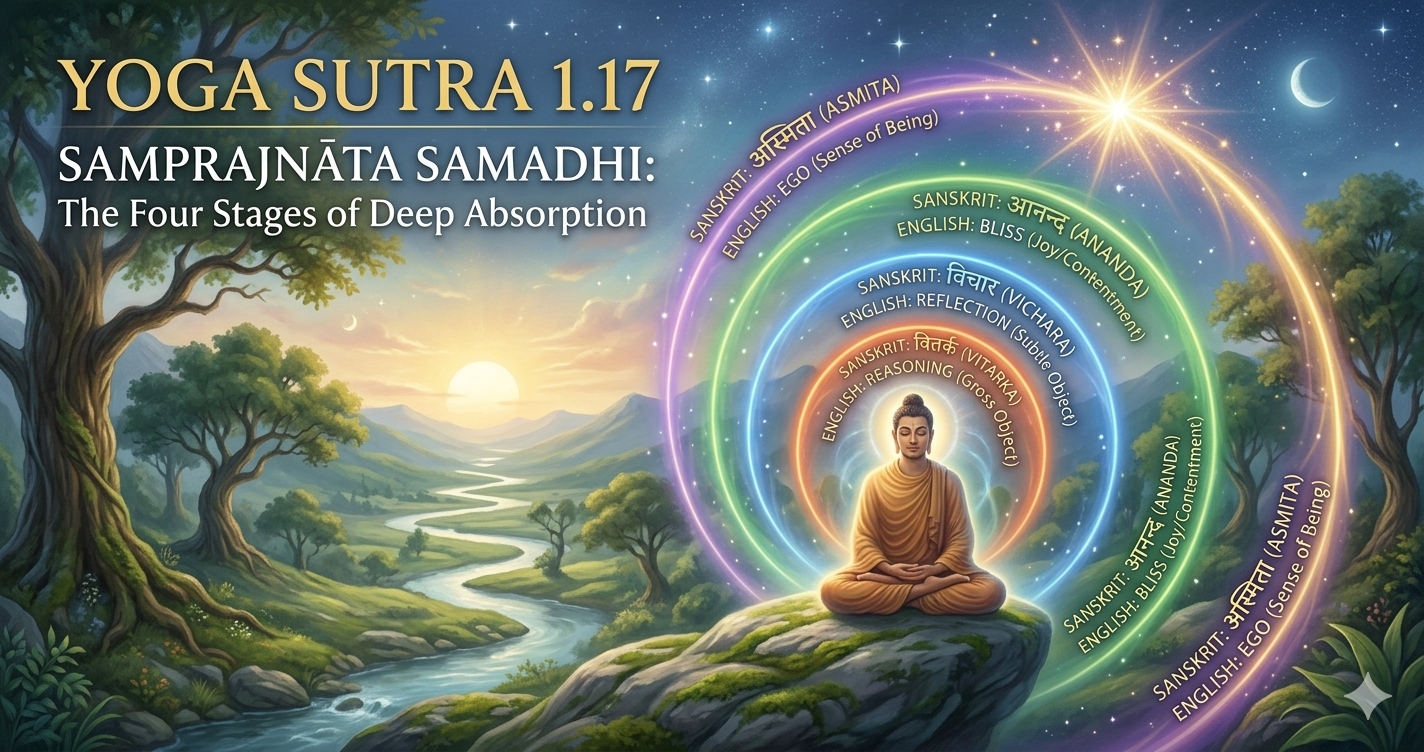
Patanjali describes four progressively subtler aspects of this absorption:
- Vitarka — reasoning or examination of the gross object
- Vicāra — subtle contemplation or investigation
- Ānanda — the experience of profound inner joy or bliss
- Asmitā — pure sense of “I-am-ness” or awareness of being
These are not simply four ordinary meditation techniques. They describe increasingly subtle levels through which the mind can become absorbed.
From the object to the experience of being
Imagine a practitioner meditating on an image or form of Shiva.
In the beginning, the mind is aware of the image as an object. There may be thoughts about its form, meaning, qualities and symbolism. As concentration deepens, the mind moves beyond the gross details and becomes absorbed in the subtler meaning and experience associated with the object.
As the absorption becomes deeper, there may be a profound sense of Ānanda — inner bliss.
Eventually, even the usual mental activity becomes extremely subtle, and there is a strong sense of simply being — Asmitā, the awareness of “I am.”
The practitioner may feel so completely absorbed that the distinction between the meditator and the object becomes extremely subtle. It can feel almost like becoming one with the object of meditation.
But there is an important point here: this is still not the final stage of Samadhi.
Why is this still not complete liberation?
At this stage, the mind has become extraordinarily quiet and focused, but there is still a subtle relationship with an object, an experience, or a form of knowing.
This is why Samprajñāta Samadhi should not be mistaken for the ultimate state simply because it feels extraordinarily peaceful or blissful.
A person may experience deep stillness, intense concentration, profound bliss and even a sense that the mind has been completely mastered. It may feel as though there is nothing more to achieve.
Yet Patanjali is taking us further.
Even bliss is an experience.
Even deep concentration is an experience.
Even the subtle sense of “I am” is an experience.
And whatever can be experienced is still within the field of Prakriti.
This connects beautifully with the distinction we explored in Sutra 1.16. Vairagya is not merely freedom from attachment to worldly objects. The deeper journey is freedom even from attachment to subtle states of consciousness.
The four dimensions of Samprajñāta Samadhi
We can therefore understand the progression as moving from the gross to the increasingly subtle:
Vitarka → Vicāra → Ānanda → Asmitā
From the gross object, the mind moves toward subtler contemplation, then profound inner bliss, and finally the subtle sense of pure “I-am-ness.”
The mind has not disappeared. Rather, its movements have become extraordinarily refined and focused.
This is why the word Samprajñāta is important — there is still a form of awareness or knowing present.
A practical understanding for everyday Yoga
We may not experience these profound states in ordinary meditation, and we should not turn them into something to chase.
But the Sutra gives us an important understanding of meditation.
When we sit quietly, the mind may initially jump between thoughts, memories, plans and emotions. With consistent practice, attention can become steadier. We may begin by concentrating on the breath, a mantra, a form, a sound or another chosen object.
The deeper lesson is not “How quickly can I reach Samadhi?”
It is:
Can I remain steadily present without constantly needing the mind to move somewhere else?
Even in our daily lives, we can practise this quality of absorption — doing one thing with full attention rather than being constantly divided between notifications, thoughts, worries and distractions.
A simple reflection
During meditation, notice:
What is my mind absorbed in?
Can I stay with one object without constantly moving away?
When peace or happiness arises, can I experience it without immediately trying to hold on to it?
This is where the teaching becomes practical.
Patanjali is showing us that the journey of Yoga moves from a restless mind, to a focused mind, to a deeply absorbed mind — and ultimately beyond even attachment to the most refined experiences of the mind.
Samprajñāta Samadhi is therefore a profound stage of inner absorption, but it is not the end of the journey.
The journey continues from concentration, to absorption, to deeper discernment — and ultimately toward freedom.
One correction I would strongly recommend keeping in your website version: “Asmitā contains the other three, but the other three are not present in Asmitā” can become confusing philosophically. It is clearer to present the four as progressively subtler aspects of Samprajñāta Samadhi, with Asmitā being the subtlest of these, rather than saying the other three are completely absent from it.