“Pratyaksha Anumana Agamah Pramanani.”
In Sutra 1.6, Patanjali introduced the five types of mental modifications, or vrittis.
The first of these is Pramana—valid or right knowledge.
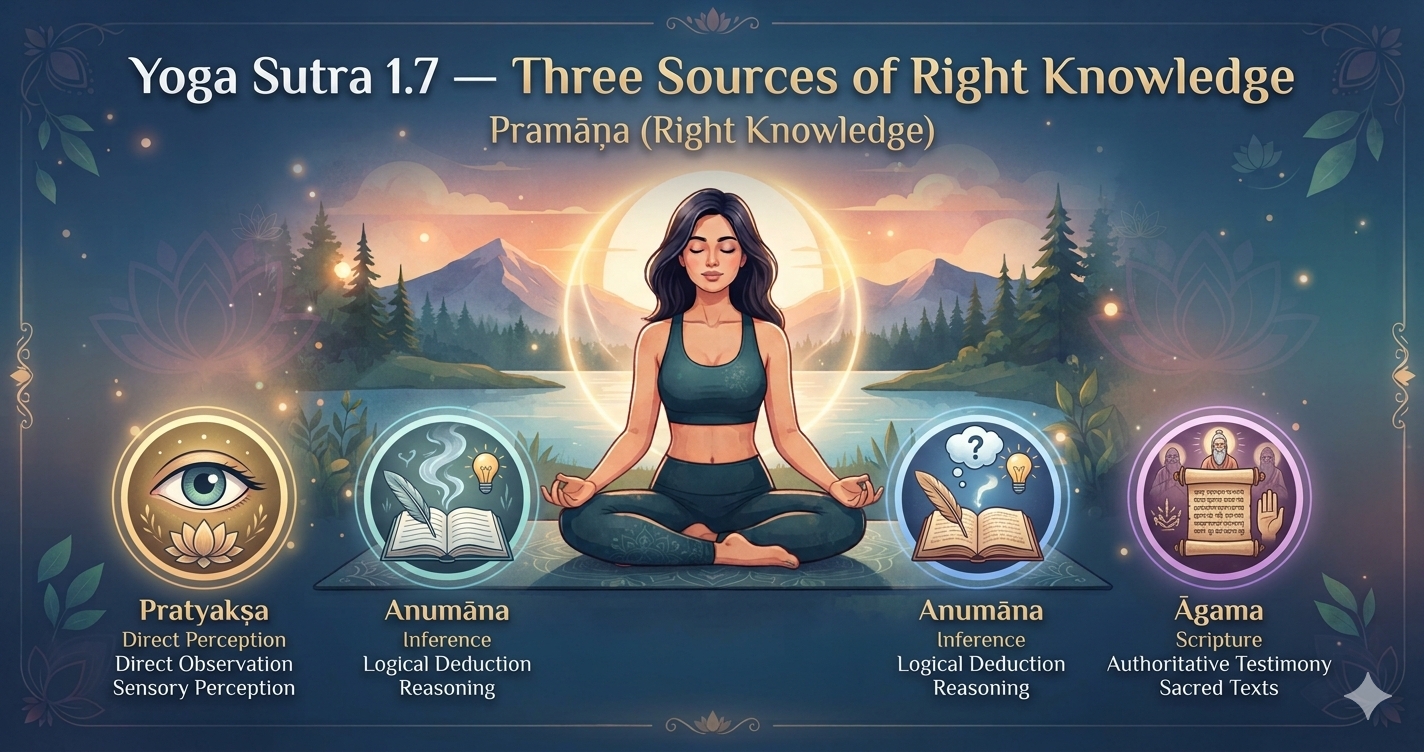
Patanjali tells us that right knowledge can arise through three sources:
Pratyaksha — Direct perception
Anumana — Inference
Agama — Reliable verbal testimony
Understanding these three is important because the way we know something influences the way we think, feel and act.
1. Pratyaksha — Direct Perception
Pratyaksha means direct perception or direct experience.
We see, hear, touch or otherwise directly experience something and gain knowledge from it.
For example, you look outside and see that the ground is wet. You directly perceive the wet ground.
But even direct perception requires awareness.
The mind can perceive something accurately and then immediately add its own interpretation.
This is why a calm and attentive mind is important—not simply for seeing, but for seeing clearly.
2. Anumana — Inference
Anumana means inference.
It is the ability to establish something based on a relationship that has been previously understood.
A traditional example is seeing smoke rising from a hill and inferring that there is fire.
You may not directly see the fire, but based on your previous knowledge of the relationship between smoke and fire, you arrive at a conclusion.
Inference is a valuable function of the intellect—but it needs to be based on a sound understanding rather than assumption.
3. Agama — Reliable Verbal Testimony
Agama refers to reliable knowledge received through the words or teachings of a trustworthy and competent source.
We cannot personally verify everything we know.
Much of what we learn comes through teachers, experienced people, texts and other reliable sources.
But Patanjali’s teaching does not suggest that we should blindly believe everything we hear.
The source must be trustworthy, knowledgeable and free from significant defects in understanding or communication.
In this way, Agama becomes a source of valid knowledge rather than mere information.
How Often Do We Jump to Conclusions?
This sutra becomes particularly interesting when we observe our own mind.
When we are caught in an emotionally charged situation, we often gather a small amount of information and quickly create a conclusion.
And once the conclusion is formed, the mind may begin searching for evidence to support it.
For example, someone doesn’t respond to your message.
What do you actually know?
They haven’t replied.
But the mind may immediately conclude:
“They are angry with me.”
“I must have done something wrong.”
“They don’t care about me.”
None of these conclusions may have been verified.
Yet we can experience real emotions based on them.
This is where our personal conditioning, memories, expectations and identification can interfere with clear understanding.
Information Is Not Always Knowledge
We live in a world where information is constantly available.
But having more information does not necessarily mean having right knowledge.
The mind may collect fragments of information and quickly combine them with past experiences, assumptions and emotions.
The result can feel completely convincing—even when it is incorrect.
A confused mind can sometimes reject something true simply because it does not fit its existing beliefs.
A steadier mind, however, learns to pause and examine.
What did I actually perceive?
What am I inferring?
What is the source of this information?
Have I verified what I believe to be true?
This is the beginning of discernment.
The Meditative Mind Sees Differently
A disciplined and meditative mind does not necessarily know more than everyone else.
It learns to look more carefully before reaching a conclusion.
Meditation develops the ability to observe thoughts without immediately becoming involved in them.
That small pause between perception and reaction can be transformative.
Instead of allowing the mind to immediately create a story, we can examine what is actually happening.
Instead of saying:
“This is definitely true.”
we can ask:
“How do I know this to be true?”
This is not indecision.
It is clarity.
Pramana in Everyday Life
Patanjali’s teaching is not limited to philosophy or meditation.
Every day, we make hundreds of decisions based on what we believe to be true.
The quality of those decisions depends partly on the quality of our understanding.
When we learn to distinguish between what we directly know, what we logically infer, and what we have received from a reliable source, we become less vulnerable to assumptions and unnecessary mental disturbance.
And this brings us closer to the purpose of Yoga—to develop a mind that is clear, steady, discerning and aware.
The next sutra explores the other side of this process:
What happens when our knowledge appears convincing, but is actually wrong?
Patanjali calls this Viparyaya—mistaken knowledge.