
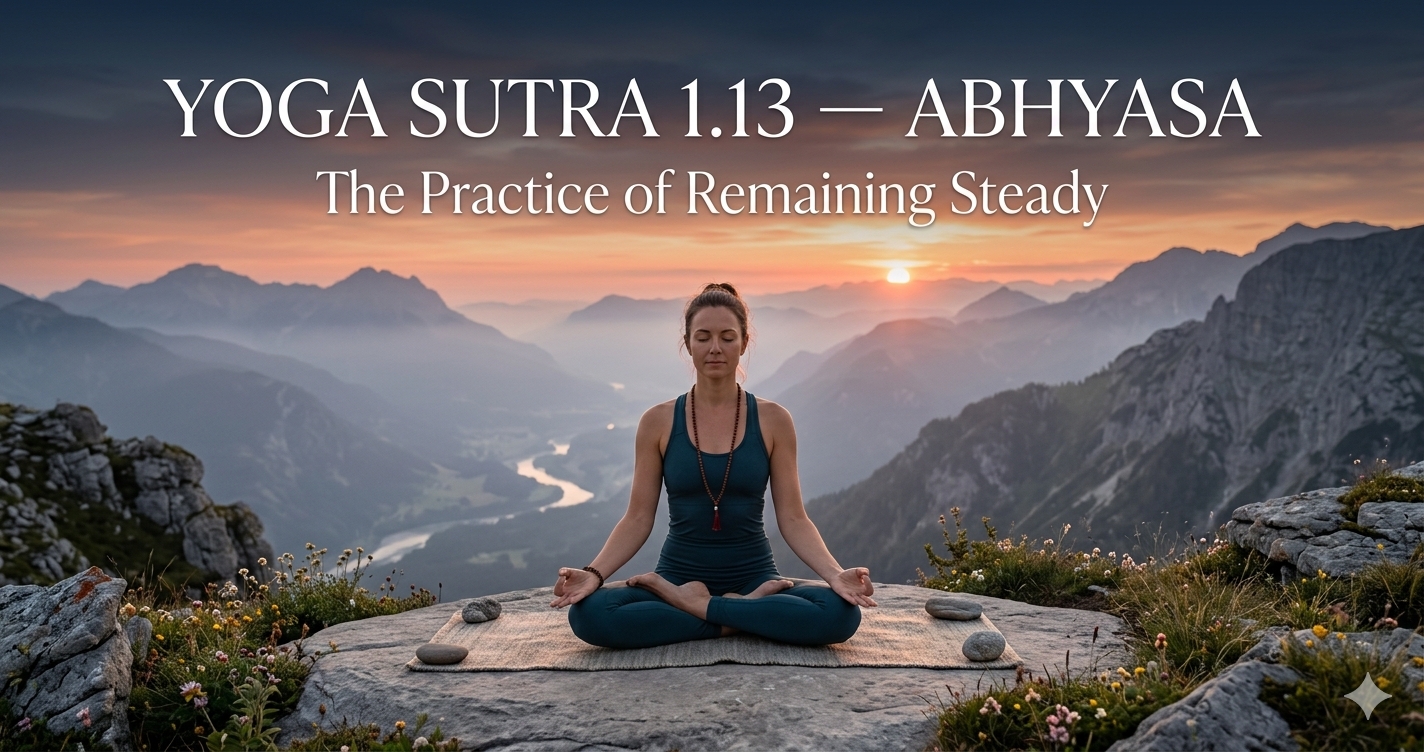
Tatra sthitau yatno ‘bhyāsaḥ
Meaning:
Abhyasa is the effort to remain established in that state of steadiness.
In the previous Sutra, Patanjali introduced two essential means for quietening the movements of the mind:
Abhyasa — consistent practice
Vairagya — non-attachment
Now, in Sutra 1.13, he explains what Abhyasa really means.
It is not simply practising Yoga postures every day.
It is the repeated effort to remain steady in oneself, even when the mind is being pulled in different directions.
Staying steady is a practice
It is easy to feel calm when everything is going according to our wishes.
The real practice begins when something disturbs us.
Someone criticises us.
Someone speaks harshly to us.
Someone insults us.
Someone behaves unfairly.
Someone says something that touches an old wound.
In that moment, the mind can react almost instantly.
We may feel hurt, angry, defensive or humiliated.
We may replay the person’s words repeatedly in our head.
We may respond immediately with equally unpleasant words.
Or perhaps we don’t say anything outwardly, but continue the argument internally for hours.
In either case, the mind has been moved by the experience.
What does Abhyasa look like in that moment?
Abhyasa does not mean pretending:
“I am not hurt.”
Nor does it mean allowing someone to disrespect or abuse us.
It means creating a small space between what happened and how we respond.
Suppose someone abuses you.
The first reaction may be:
“How dare they speak to me like that!”
Instead of immediately reacting, pause.
Take a breath.
Observe what is happening within you.
“I am feeling hurt.”
“Anger is arising.”
“My mind wants to retaliate.”
You have not denied the emotion.
You have simply become aware of it.
Then another question becomes possible:
“What is actually happening here?”
Perhaps the person’s behaviour says more about their own state than about your worth.
Perhaps they are carrying frustration, insecurity, fear or their own unresolved patterns.
Perhaps there is something useful for you to learn from what was said.
And perhaps there is absolutely nothing constructive in their behaviour — in which case, you can still choose an appropriate boundary without allowing their words to control your inner state.
That is Abhyasa.
From reaction to response
There is a significant difference between reaction and response.
A reaction is immediate and often driven by an old pattern.
A response contains awareness.
You may still choose to speak firmly.
You may choose to walk away.
You may choose to set a boundary.
You may even choose to confront the person.
But the action comes from a more centred place rather than from being completely carried away by anger or hurt.
This is not weakness.
It is inner strength.
Can we even be grateful for a difficult person?
Sometimes, yes.
Not because the person’s behaviour was right.
But because the situation may reveal something about ourselves that we had not noticed.
Perhaps it shows us:
“I am extremely sensitive to criticism.”
“I need external approval more than I realised.”
“I still carry anger from an old experience.”
“I need to learn how to set healthier boundaries.”
The difficult person may unknowingly have shown us an area where there is still work to do.
In that sense, even an unpleasant experience can become an opportunity for self-observation and growth.
We don’t have to thank someone for hurting us.
But we can sometimes be grateful for what the experience revealed within us.
A simple Abhyasa practice
The next time something triggers you, remember these three steps:
PAUSE
Don’t react immediately.
OBSERVE
“What is happening inside me right now?”
CHOOSE
“What response will keep me aligned with the person I want to become?”
The first time you do this, it may feel difficult.
The tenth time, you may notice a little more space.
With continued practice, that space can become larger.
And gradually, what once triggered an immediate reaction may no longer have the same power over you.
The deeper message of Sutra 1.13
Abhyasa is not a one-time decision.
It is a daily practice of returning to steadiness.
You may lose your patience today.
You may react tomorrow.
You may get carried away by anger, fear or hurt next week.
That does not mean the practice has failed.
Notice it.
Learn from it.
And begin again.
Every return is part of the practice.
Patanjali is reminding us that a steady mind is not something we achieve once and possess forever.
It is something we cultivate repeatedly.
And perhaps that is the real meaning of Abhyasa:
Not “I will never react again.”
But “Every time I lose my centre, I will learn to return.”