Dṛṣṭānuśravika-viṣaya-vitr̥ṣṇasya vaśīkāra-saṁjñā vairāgyam
Meaning:
Vairagya is the state of mastery in one who is free from craving for objects and experiences that have been seen or heard about.
After explaining Abhyasa — consistent practice, Patanjali now takes us deeper into the second principle introduced in Sutra 1.12:
Vairagya — non-attachment.
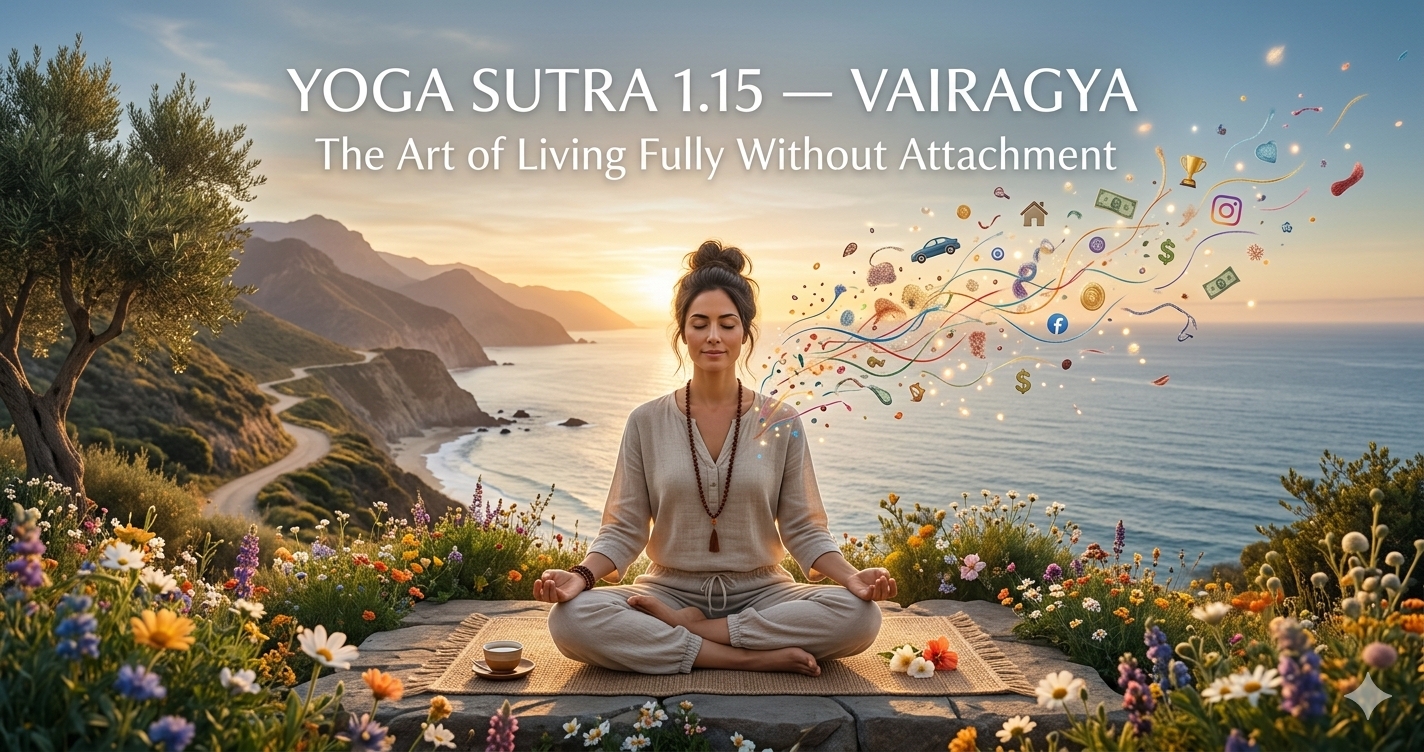
Vairagya is often misunderstood as giving up ambition, comfort, pleasure or material possessions. But Patanjali is pointing towards something subtler: the ability to participate fully in life without becoming dependent on external things for inner contentment.
Vairagya does not mean giving up your desires
There is nothing wrong with having goals.
You can aspire to financial success, build a career, create a beautiful home, travel, enjoy good food and appreciate comfort.
The question is not “Do I want this?”
The deeper question is:
“If I don’t have this, can I still be at ease?”
You may work sincerely towards something and enjoy it when it comes. But if circumstances change, Vairagya allows you to remain grounded.
This is not suppression of desire. It is freedom from compulsive craving.
Two people, the same success
Imagine two people who have achieved considerable success. Both have money, beautiful homes, comfortable lifestyles and the freedom to enjoy expensive things.
One constantly needs more recognition, more possessions and more achievement. There is a fear of losing what has been acquired, comparison with others and a strong identification with success.
The other enjoys the same comforts but remains content. They continue to grow and pursue ambitions, but their self-worth does not depend upon what they own or how others perceive them.
The difference is not their lifestyle.
It is their relationship with it.
Be an Urban Yogi
This makes Vairagya particularly relevant to modern life.
You don’t have to leave the city or reject material comforts to practise Yoga.
You can live in a busy city, have a successful career, earn well, own beautiful things and still cultivate Vairagya.
The Urban Yogi asks:
Can I enjoy without excess?
Can I achieve without making achievement my identity?
Can I possess without becoming possessive?
Can I accept change without losing my inner balance?
This is not an easy state to cultivate because modern life constantly encourages us to want more. Even after achieving something, the mind quickly moves towards the next desire.
Vairagya invites us to recognise this tendency and develop contentment alongside aspiration.
A simple practice
The next time you strongly desire something, pause and ask:
Why do I want this?
Then ask:
“If I don’t get it, can I still be okay?”
You may discover that the desire itself is perfectly healthy.
Perhaps you still want the promotion, the holiday, the home or the purchase.
That’s fine.
The practice is simply to pursue it without making your peace dependent upon getting it.
The deeper message of Sutra 1.15
Vairagya is not measured by how little we possess.
It is reflected in how freely we can live with what we possess.
We can enjoy the world without being consumed by it.
We can be ambitious without being restless.
We can prosper without becoming possessed by our possessions.
We can appreciate what we have while remaining at peace when life changes.
Live fully.
Aspire sincerely.
Enjoy what comes.
And remain inwardly free.
That is the spirit of Vairagya — the art of being in the world without being bound by it.