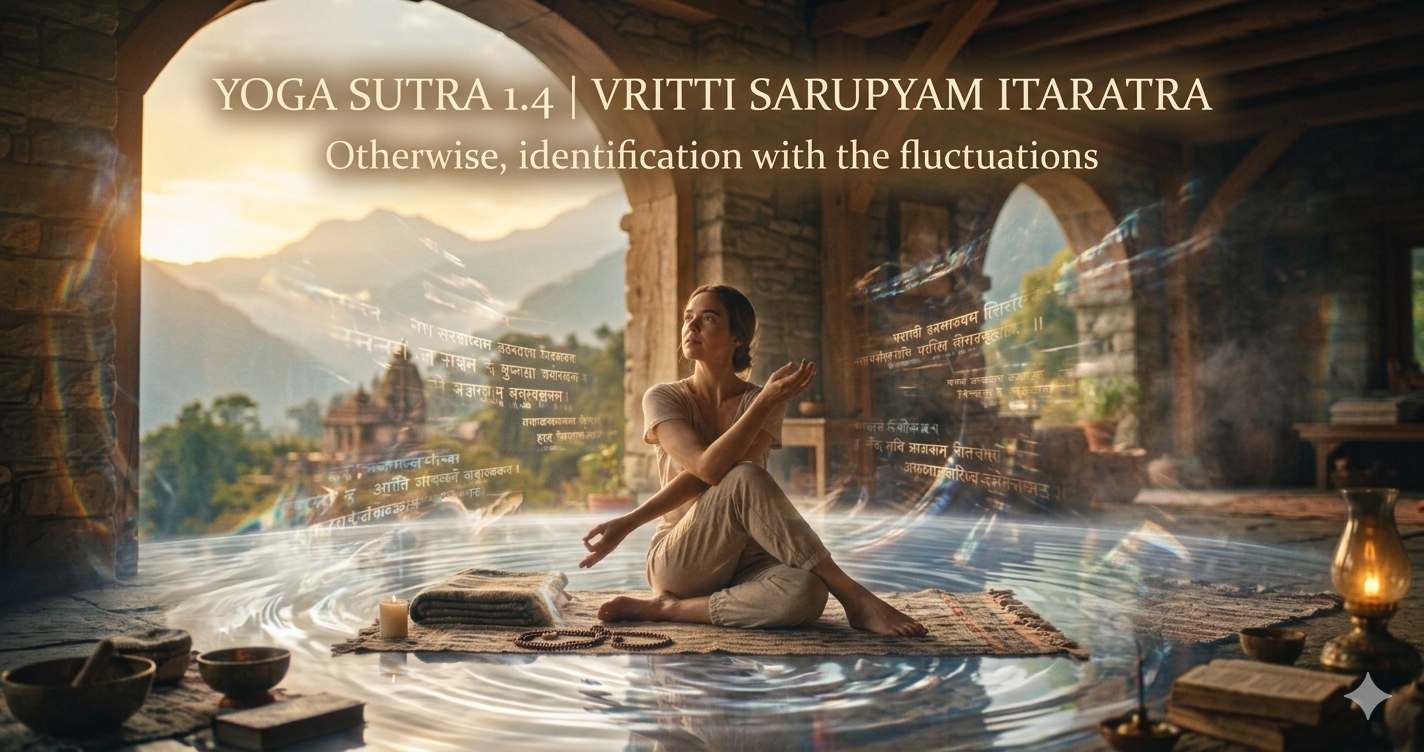
“Vritti Sarupyam Itaratra.”
In simple words, Patanjali tells us:
“At other times, we identify ourselves with the modifications of the mind.”
The previous two sutras showed us an important possibility.
In Yoga Sutra 1.2, Patanjali explains that Yoga is the stilling of the fluctuations of the mind.
In Yoga Sutra 1.3, he tells us that when these fluctuations become still, the Seer rests in its own true nature.
But what happens when the mind is not still?
That is what Patanjali explains in Sutra 1.4.
When We Forget Who We Truly Are
When we are not established in awareness, we easily become identified with whatever is happening in the mind.
A thought arises—and we become the thought.
An emotion arises—and we become the emotion.
Someone criticises us—and suddenly we feel “I am being attacked.”
Something goes wrong—and we begin to think “I am a failure.”
We experience sadness—and instead of observing the sadness, we become completely absorbed in it.
This is Vritti Sarupyam—taking the form of the mental modification that is occurring at that moment.
The mind creates an experience, and we unconsciously begin to identify ourselves with it.
An Everyday Example
Imagine that you are already feeling low or experiencing sorrow. Someone then says something critical or blames you.
The words themselves are one experience.
But then the mind starts creating its own story:
“Why did they say that?”
“Maybe they are right.”
“Nobody understands me.”
“I am not good enough.”
The original situation may have lasted only a few seconds, but the mind continues replaying it.
The criticism becomes a thought.
The thought becomes an emotion.
The emotion becomes identification.
And identification creates further mental disturbance and suffering.
This is what Patanjali is drawing our attention to.
The problem is not simply that a thought or emotion arises. The deeper problem is that we mistake that temporary mental experience for who we are.
The Mind Changes. The Seer Observes.
Our thoughts are constantly changing.
Our emotions change.
Our opinions change.
Our circumstances change.
Our roles change.
Yet there is something within us that can observe all these changes.
That is the Drashta—the Seer.
When we forget the Seer and become completely absorbed in the changing movements of the mind, we lose our inner centre.
We start living according to every thought, reaction and emotion that appears.
Patanjali’s teaching therefore becomes a gentle warning: even after getting a glimpse of our deeper nature, we can repeatedly return to identification with the mind if we do not cultivate awareness.
From Reaction to Awareness
Yoga does not mean that we will never experience anger, sadness, fear, disappointment or hurt.
These experiences are part of being human.
The practice is to learn to observe them without immediately becoming them.
Instead of:
“I am angry.”
we begin to recognise:
“Anger is arising within me, and I am aware of it.”
Instead of:
“I am hurt.”
we can pause and notice:
“There is hurt being experienced, and I can observe it.”
That small space between the experience and our identification with it is where awareness begins to grow.
The Practice of Yoga
Sutra 1.4 connects beautifully with the previous sutras.
When the mind is still, the Seer rests in its own nature.
When the mind is not still, we tend to identify with whatever the mind is experiencing.
The journey of Yoga is therefore not about escaping our thoughts or emotions. It is about developing the awareness to recognise them for what they are—movements of the mind, not the entirety of who we are.
The more we practise concentration, meditation, mindful breathing and self-observation, the more clearly we begin to notice this distinction.
A thought may come.
An emotion may arise.
A situation may disturb us.
But we do not have to become it.
We can observe it.
And in that moment of observation, we begin to return to the deeper awareness that Patanjali calls the Seer.
A Practical Reflection
The next time someone says something that hurts or criticises you, pause before reacting.
Take one conscious breath and ask yourself:
“What is happening within my mind right now?”
Rather than immediately saying “This is me,” simply observe:
“This is a thought.”
“This is an emotion.”
“This is a reaction.”
That simple act of witnessing creates distance between you and the vritti.
And that distance can become the beginning of freedom from unnecessary mental suffering.
Yoga begins not when we stop having thoughts, but when we stop mistaking every thought for who we are.