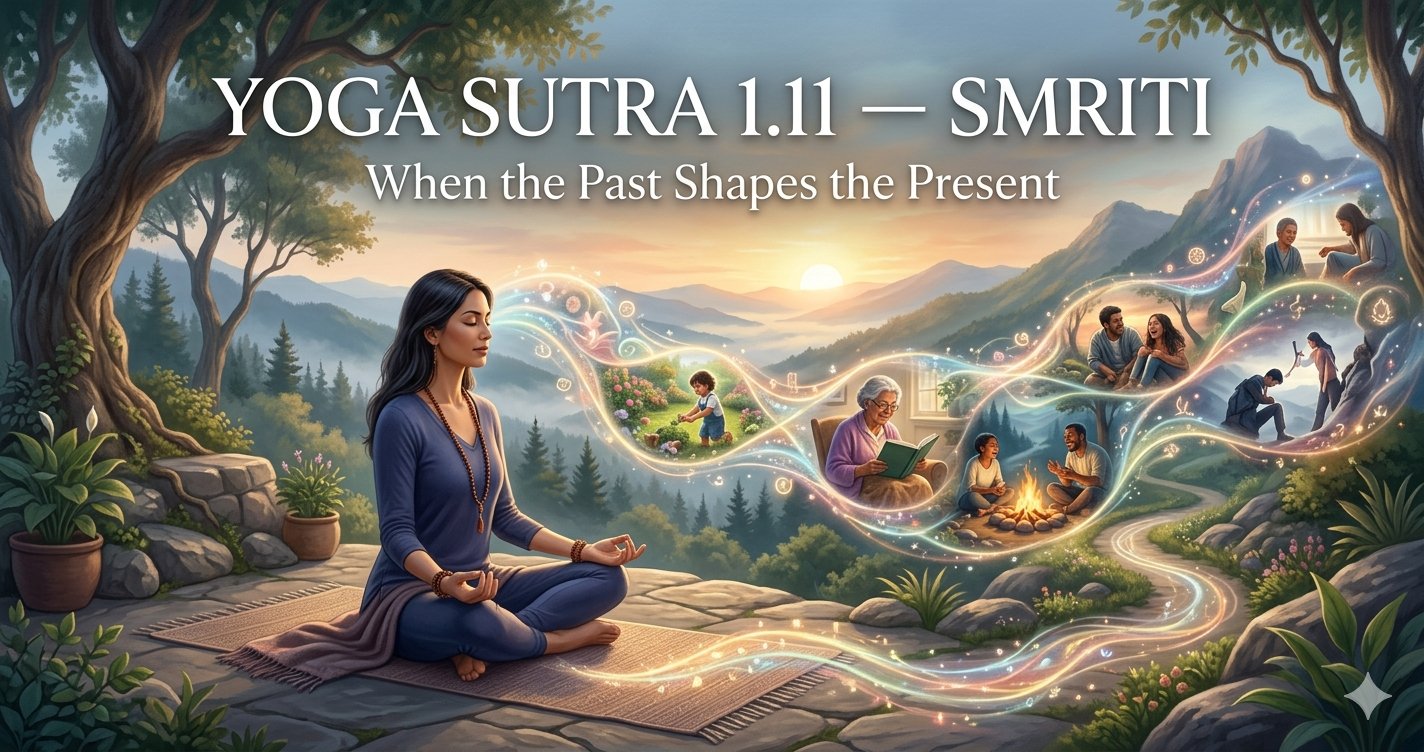
Anubhūta-viṣayāsampramoṣaḥ smṛtiḥ
Meaning:
Smriti, or memory, is the retention of an experienced object or experience, allowing it to be recalled.
With this Sutra, Patanjali introduces the fifth type of Vritti — Smriti, or memory.
Memory is the mind’s ability to retain impressions of what we have experienced and bring them back into awareness.
We remember people, places, conversations, sensations, emotions, successes, failures and countless experiences from our past.
Memory is essential to everyday life. It helps us learn, recognise people, use our skills and make informed choices.
But there is another side to memory.
When the past enters the present
Memory becomes limiting when we are no longer simply remembering the past, but continuously living through it.
Something may happen in the present, but instead of experiencing it freshly, the mind immediately compares it with something that happened before.
We may think:
“This reminds me of what happened last time.”
“I have already experienced this.”
“I know how this will turn out.”
The present moment is then filtered through an old impression.
This can make our experiences repetitive. We may stop seeing what is actually happening now because the mind is busy reproducing what it already knows.
A simple example
Imagine an adult walking onto a beautiful beach.
A child may immediately run towards the water, feel the sand between their toes, watch the waves, collect shells and become completely absorbed in the moment.
An adult may also experience that joy — but sometimes the mind is somewhere else.
Thinking about work.
Replaying a conversation.
Worrying about tomorrow.
Remembering something unpleasant.
Comparing this beach with another place.
The beach is right there, but the mind is elsewhere.
The experience is happening in the present, while the mind is living in the past or future.
This is one of the ways memory can quietly interfere with our ability to experience the present moment.
Should we stop remembering?
Absolutely not.
Memory is not the problem.
In fact, we need memory to learn, grow and function in the world.
The yogic approach is not to destroy memory or force ourselves to forget the past. Instead, we learn to change our relationship with memory.
Let the memory be there.
Recognise it.
Learn from it when necessary.
But do not allow it to take over every present experience.
There is a difference between:
“I remember what happened.”
and
“I am still living what happened.”
The first is memory.
The second can become identification.
Memory can be pleasant too
Not all memories are painful.
A beautiful childhood memory, a loved one’s smile, a successful achievement or a meaningful experience can bring warmth and happiness.
But even pleasant memories can pull us away from the present when we constantly compare today’s experience with yesterday’s.
We may spend so much time thinking:
“Those were the best days.”
that we fail to notice the beauty of what is happening today.
The goal is not to reject the past.
The goal is to remember without being trapped by remembering.
A small practice: Remember, then return
The next time a memory suddenly appears while you are doing something, don’t fight it.
Simply notice:
“A memory has arisen.”
Take one conscious breath.
Ask yourself:
“Do I need to stay with this memory right now?”
If there is something useful to learn from it, take the learning.
Then gently bring your attention back to what is actually happening right now.
If you are eating, taste your food.
If you are walking, feel your steps.
If you are with someone you love, truly listen to them.
If you are at the beach, look at the waves.
Remember when necessary.
Learn when useful.
Return to the present when the memory has served its purpose.
The deeper lesson of Sutra 1.11
Memory is one of the natural movements of the mind. We cannot — and do not need to — erase it.
What Yoga offers is awareness.
When we become aware that the mind is repeatedly travelling into the past, we have a choice: continue following the memory, or gently return to the present.
The past has its place.
It can teach us, guide us and give meaning to our journey.
But it should not become the place where we permanently live.
Yesterday can be remembered.
Tomorrow can be planned.
But life can only be experienced now.
And perhaps this is one of the simplest practical teachings of Yoga:
Don’t try to empty the mind of its memories.
Learn to keep the memories without allowing them to steal the present.
With Smriti, Patanjali completes his description of the five types of Vrittis introduced in Sutra 1.6 — Pramana, Viparyaya, Vikalpa, Nidra and Smriti. The next Sutras begin to explore what strengthens these mental modifications and how they can be regulated through practice and detachment.